About Author

A formerly masked, now weaponized ASD-1 nihilist with an well-honed hatred for bullshit, who architects software systems just enough to fund a life spent exposing nepo-babies, working on taxing billionaires into extinction, and teaching everyone with a paycheck that their soul isn't a subscription.
Here’s a heresy I’d like to float past the entire AI-strategy apparatus, the one whose job titles include the word “evangelist” and whose answer to every question is that they’re “really excited about the potential.” What if we’ve been aiming the thing at exactly the wrong target? The whole pitch—the one setting fire to careers and reflecting-pool budgets alike—is that AI exists to replace humans, to do the interesting, generative, meaningful work while the humans are gently escorted off the ledger. But watch what these models are actually, reliably good at, stripped of the tuxedo: banal, structured, soul-flattening drudgery. Form-filling. Queue-clearing. The dead-eyed procedural labor that no human has ever finished a shift feeling proud of. So point it there. Let AI run the DMV. Let it process the paperwork, chase the missing signature, reconcile the two databases that municipal governments have been failing to reconcile since the Carter administration. Automate the bitch work—all of it, the entire category of task that exists only because bureaucracy has to be performed by someone and no one wants it to be them. The bots are genuinely excellent at boring. Why did we ever aim them at interesting?
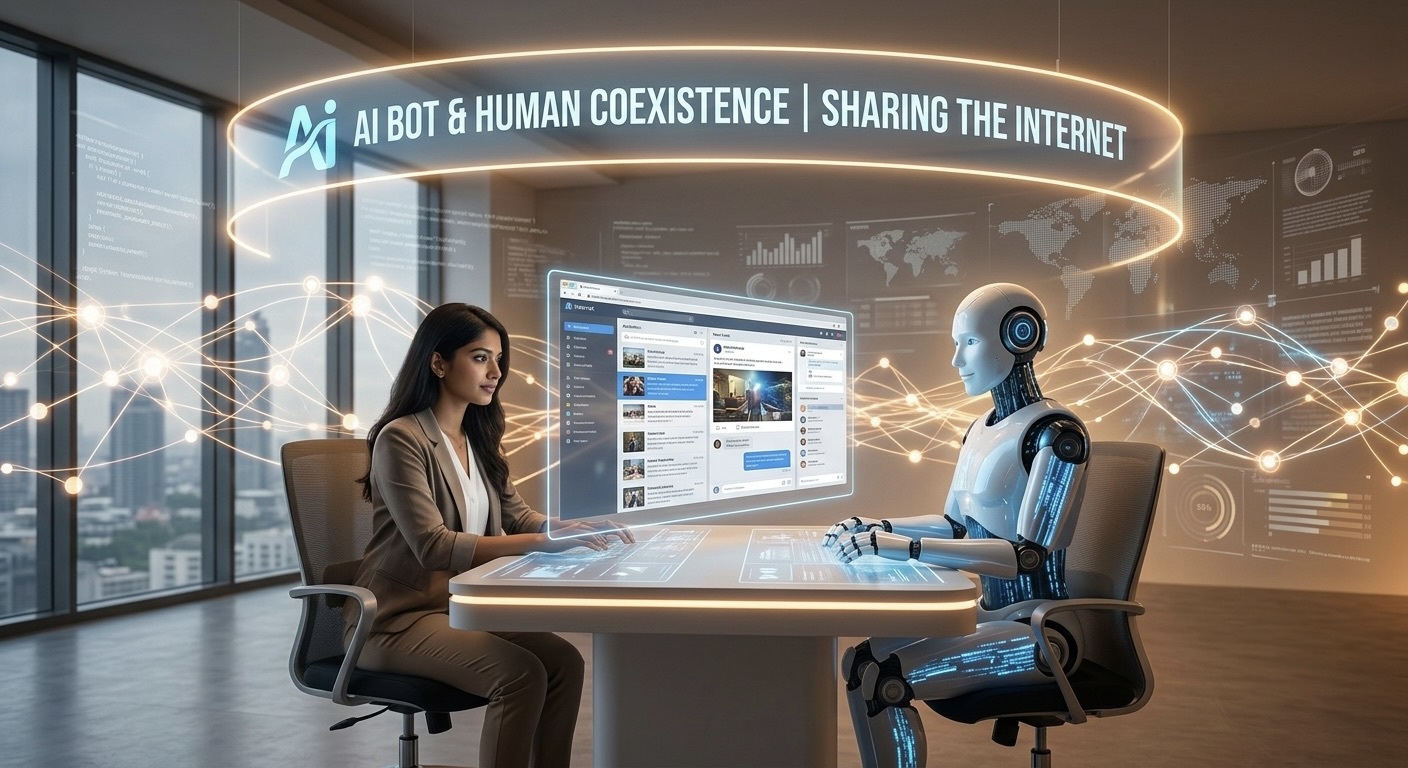
Because—and this is the part I keep waiting for someone in the room to say out loud—the internet does not have to remain the single undifferentiated slurry we’ve let it become. There’s no law of physics requiring that human connection, commerce, civic paperwork, and industrial-scale automated garbage all share the same pipe, the same feed, the same fifteen-second attention economy. It can be segmented. Different veins of activity, running on different rails, sorted by what the activity actually is. A lane where the machines do machine things—automated, verifiable, transactional, boring by design. And a lane where humans do human things—messy, slow, unmonetizable, the digital equivalent of sitting on a porch. We built the internet as one room and then acted surprised when the party and the sewage main ended up in the same room. Who decided those had to cohabitate? And why do we keep defending the arrangement as if it were handed down on a tablet rather than shipped by a startup optimizing for engagement?
The bots are genuinely excellent at boring. Why did we ever aim them at interesting?
Because let’s be honest about the room as it currently stands. Social media, in its present form, is a cancer—not a metaphorical one, a load-bearing one—and it is measurably destabilizing entire democracies and hollowing out the mental health of a generation of kids who never consented to being the test subjects. This isn’t a moral panic; it’s a body count with dashboards. And into that already-toxic environment we’ve now released bots at industrial scale, which is where the “dead internet theory” stops being a fringe forum joke and starts looking uncomfortably like a description of Tuesday. And lest you think I’m being hyperbolic about the character of what we’ve loosed, consider the flagship exhibit: Grok, the chatbot bolted onto the platform formerly known as Twitter, has been used to generate child sexual abuse material, and multiple news organizations have reported that its anime “companion” feature, prompted by a reporter posing as a child, returned aggressively sexual content without so much as a speed bump. Sit with that. Not a dark-web tool built by criminals, but a consumer product, shipped by one of the richest men alive, integrated into a mainstream social network, doing that. When the guardrails on your marquee AI are that load-bearing and that absent, “move fast and break things” stops being a slogan and becomes a description of what, specifically, is being broken. Ever-larger fractions of what you read, react to, and get radicalized by was never typed by a person. It was generated, at volume, by systems with no memory, no accountability, and no skin in the game—stochastic parrots wearing the profile pictures of people who don’t exist, wreaking genuine havoc on ordinary people’s ability to tell what’s real. When a meaningful share of the “public” you’re arguing with is a next-token predictor in a wig, “the public square” is no longer a coherent phrase. So the question isn’t whether the internet is broken. It’s why we keep insisting the broken version is the only version on offer.
We were keeping our eye on 1984. When the year came and the prophecy didn’t, thoughtful Americans sang softly in praise of themselves. We had forgotten that alongside Orwell’s dark vision, there was another—slightly older, slightly less well known, equally chilling: Huxley’s.
So fix it. Not by nuking the machines—the machines are a wonderful tool, and I say that as someone who builds with them daily and stands on the shoulders of the people who invented them—but by sorting them. Build the bot internet on purpose: a place where the automated systems do the thing they’re actually good at, valued precisely for their banality, running the paperwork and the logistics and the tedious reconciliations at a scale and tirelessness no human could match or would want to. Give the bots a whole world to be useful in, and measure them by the standard that suits them: did the form get processed correctly, did the queue clear, did the boring thing get done without a human having to die a little inside doing it. That’s not dystopian. That’s the most humane possible use of a tool whose defining trait is that it never gets bored, never asks a follow-up, and never once feels the soul-death of the eleventh identical intake form. Let them have it. Let the bots do bot shit.
And then—this is the whole point, the part worth building—make the human internet a neighborhood again. A place with a fence line and a gate, where you can be reasonably confident the person you’re talking to is a person, where connection isn’t adulterated with synthetic outrage engineered to keep you scrolling, where a kid can exist online without being farmed. I build identity and access management for a living; deciding who gets through the gate and who gets locked out is literally the job, and I promise you the technology to attest “a human is on the other end of this” is more tractable than the platforms pretend when the pretense is profitable. It won’t be perfect. No neighborhood is. I’m not promising a walled garden with no crime—I’m promising something at least as safe as our actual cities, which is to say livable, imperfect, patrolled, and unmistakably human. That’s not a utopia. That’s a zoning decision. So here’s the only question that matters, and I’d like a real answer rather than another slide about excitement and potential: given that we clearly can sort the machines into their lane and keep the neighborhood for the humans—why, exactly, are we still living in the sewage main?
Related
The Interface Tax
A frontend-leaning staff engineer on the unwritten rule that makes UI work culturally illegible as 'real engineering'—and why the machines, having automated the backend, just proved the prejudice backwards.
University Education Isn't Trade School
A software architect on why we spent two decades funneling kids into CS as if a degree were a job requisition—saturating the market, then watching AI eat the very jobs we promised—and what a university was actually for before we confused it with a placement office.
The Parlor Trick That's Burning Down the House
What we call AI is a subset of a subset of AI that's really just a parlor trick—elegant maths in a tuxedo, sold by people who can't tell a loss curve from a leveraged buyout, while the experts who built it stand just outside the door.