About Author

A formerly masked, now weaponized ASD-1 nihilist with an well-honed hatred for bullshit, who architects software systems just enough to fund a life spent exposing nepo-babies, working on taxing billionaires into extinction, and teaching everyone with a paycheck that their soul isn't a subscription.
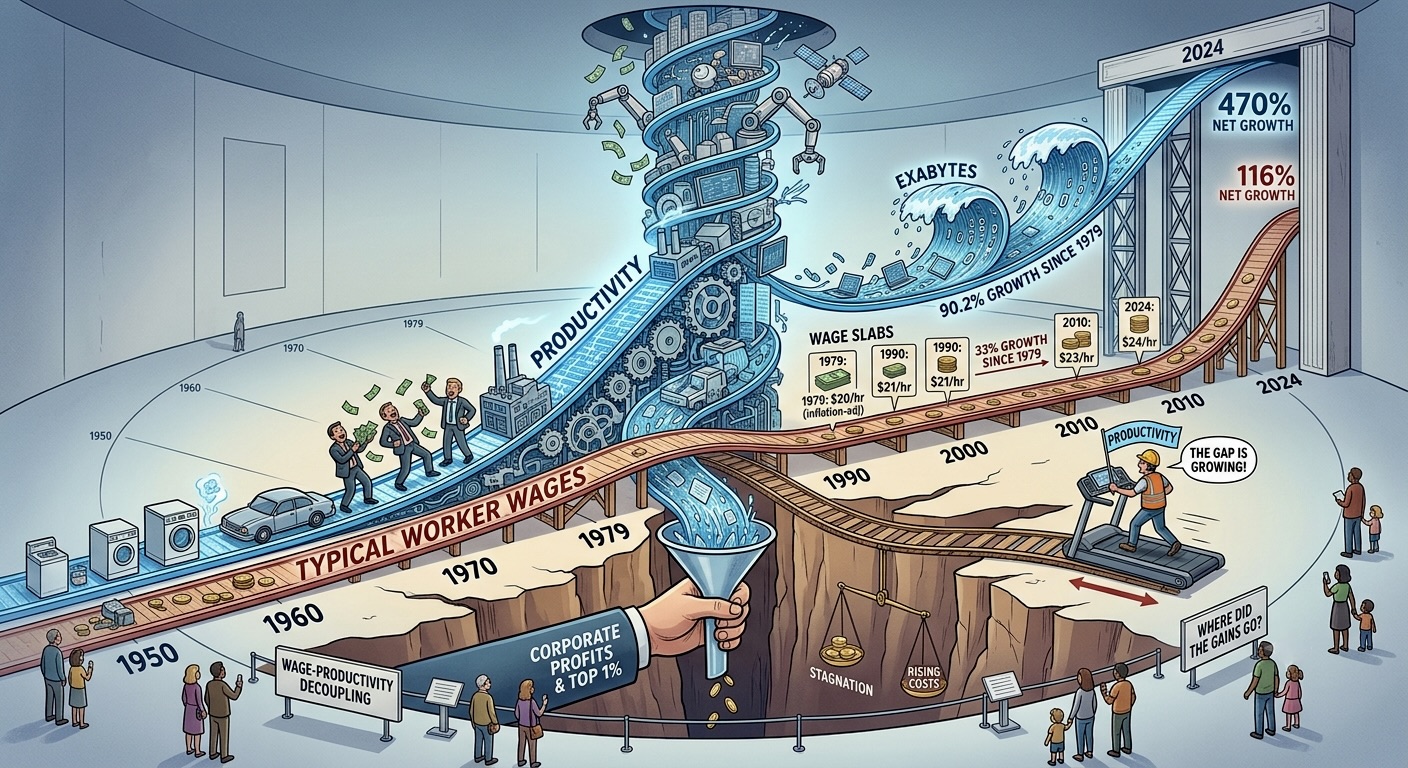
I added “Open to opportunities” the second my raise didn’t match inflation—and so should you. Not as some LinkedIn thought-leader koan where I’ve gamified my personal brand into a funnel. I mean it descriptively, almost taxonomically: the moment my compensation stopped being compensation and quietly became an actuarial bet that I wouldn’t notice, I flagged myself available. Not disloyal. Available. The distinction matters, because loyalty hasn’t been on the menu since the late 1970s, when some McKinsey acolyte realized you could juice a quarterly earnings call by reclassifying labor from asset to friction cost. Ever since, the pretense that business is personal—that your “work family” will protect you—has curdled into something between gaslighting and light fraud. Lovely family, though. Very warm. Right up until the reorg.
Business isn’t personal. It never was. What it increasingly is, is adversarial—not merely between firms scrapping over market share, which is at least honest in a Hobbesian way, but between the firm and its own employees, and between the firm and its own customers. You can hear it in the vocabulary: “human capital,” “revenue extraction,” “churn.” You can see it in the architecture of the thing I’m actually paid to build—identity and access management, where the genuine security problem of verifying a human being mutates, almost imperceptibly, into a surveillance apparatus that clocks bathroom breaks and flags “productivity anomalies” for a manager whose entire emotional range is the serene certainty of a man who has never had an original thought and never had to have one. He sits in a glass office and says “doing more with less” as though he’d discovered a law of thermodynamics rather than lifted it off a 1994 Jack Welch earnings call. He isn’t even malicious. He’s just the finished product of a system that selects for the smooth-brained confidence of inherited advantage and files it under leadership. I don’t hate people. I do, specifically, hate watching a man whose signature intellectual achievement is knowing which fork to use lecture a room of working engineers about “velocity” while being physically unable to format a pivot table. That’s the politics I mean when I say corporate politics: the performative intelligence of the unqualified, the theatrical earnestness of people who’ve never built anything but a narrative about why they deserve more than you. What would he do if the narrative ever got audited?
And yes, I’m aware I’m saying this from a position that once required a decade of masking simply to hold a cubicle. I’m ASD-1—what the DSM used to file as Asperger’s, until the neurodiversity movement made it briefly fashionable to admit you’re not neurotypical, right around the time corporations noticed that “autism hiring initiatives” were cheaper than fixing their broken management. For the first ten years I hid it. I learned to perform eye contact like a second language, to modulate my tone so I didn’t sound like a machine dissecting your logical fallacies in real time, to feign enthusiasm for the company picnic. Then, for about five golden years, the mask could come off a little—suddenly big tech wanted “cognitive diversity,” which meant they’d tolerate my flat affect as long as the pull requests were clean and I didn’t ask why we were setting hundreds of millions on fire for a rebrand. I got to be the “eccentric architect” instead of the guy who doesn’t blink. And now? 2024 arrived, hatred came back as a limited-time nostalgic entrée, and the neurodivergent, the LGBTQ, the minority—anyone who isn’t the factory-default human—are all quietly invited to resume hiding. Be grateful you have a job. Don’t make waves. Smile at the party. I’ll pass. I decline to perform gratitude for a paycheck that no longer keeps pace with the inflation their own monetary policy produced.
Let me be precise about who I hold in contempt, because I’m not an equal-opportunity misanthrope. I reserve it entirely for corrupt elected officials, abusive executives, crooked bankers, and anyone else in a position of power who exploits labor. Not the middle manager, who’s as trapped as I am—I mean the people who design the trap. The conservative supermajority on the Supreme Court who decided corporations are people and money is speech, then spent the recess on the yachts of billionaires disinclined to pay tax. The only justices I follow with any enthusiasm are the ones who occasionally file a dissent that reads like a philosopher-king quietly disassembling a room of village idiots—and even then my patience is thin, except for KBJ. That woman’s footnotes are savage.1 She writes a dissent like she’s filing a legal brief with a shiv tucked in the citations. I’d read a thousand pages of her laying waste to originalist logic with the cool precision of someone who knows the canon better than the men claiming to interpret it. She reminds me of what I loved about my Oxford tutorial education: the quiet, brutal dismantling of a bad argument by someone who’s actually read the sources.
I got that education because I was a strange kid who read too much, and because the system, whatever its faults, still had a scholarship pathway that occasionally let someone like me slip through. Maths and Philosophy, minors in History and Biblical Studies, in a tutorial system that makes you defend every premise aloud while a don who’s been doing this since before you were born regards you like an insect that wandered onto his notes. I read the classics. I fell for Shakespeare—the tragedies and the histories, the bleak unsparing ones where everyone dies and no one learns anything, not the comedies where mistaken identity somehow resolves into marriage. You want to understand corporate dysfunction? Read Coriolanus: a man too proud to perform humility for the mob, destroyed by the tribunes who weaponize his authenticity against him. Or King Lear, where the one daughter who refuses to flatter gets exiled, and the whole kingdom turns out to be built on a lie. I love the philosophers who told the truth about power. Hobbes, who saw life as solitary, poor, nasty, brutish, and short—and then took a job justifying a monarch. Hume, who punctured causality and religion so gently that nobody noticed the Enlightenment had already detonated. Descartes, who tried to think his way to God and accidentally invented solipsism. Heidegger, a Nazi and a genuinely bad man, who was nonetheless the one who correctly noticed that modern technology treats the world—and by extension human beings—as “standing-reserve,” raw material to be ordered and optimized. Arendt, who watched Eichmann’s trial and saw not a monster but a bureaucrat who’d made evil banal. Durkheim, who diagnosed anomie, the dislocation of a society that’s lost its normative structure—which is precisely what you feel when your company announces a return-to-office mandate in a town hall the CEO dials into from his beach house. And Jacques Maritain, the Catholic personalist who argued that a human being is not a mere unit of economic function but a whole, incommunicable self oriented toward the common good—a notion so alien to modern capitalism that reading him feels like archaeology.
Since college I’ve put hundreds of hours into The Great Courses—Economics, AI, Game Theory, Machine Learning, Trade, Macro, the Economics of Uncertainty, Early European Philosophy, Early American History—because my mind won’t stop. The ASD-1 means I absorb information like a sponge in a flood, and I don’t get to choose what sticks. The net result is a nihilist who can’t stop caring. I’m a software architect at a 5,000-person enterprise SaaS company specializing in identity and access management, which means I spend my days building the systems that decide who gets to enter the kingdom. It’s philosophically rich work, if you’re a particular kind of deranged, because identity is a construct, access is a proxy for trust, and management is a euphemism for control. And I watch us slowly, methodically replace human agents with AI bots—not because the bots are better (they aren’t; they hallucinate, they amplify bias, they turn edge cases into incidents) but because bots don’t unionize, don’t ask for raises, don’t ask awkward questions about equity. The company says “augmentation.” The company says “efficiency.” The company says “freeing up your time for higher-value work,” a lie so transparent it’s almost sweet. What it means is: you are a cost center, we will automate you the instant the maths clears, and in the meantime we’ll log your keystrokes to train your replacement on your own labor. It’s automated grave-robbing with a wellness webinar attached.
And the customer? Oh, the customer is also the enemy now. We monopolize every market so the customer never gets the chance to leave. We acquire competitors not to integrate their technology but to euthanize it. We make cancellation require a notarized blood oath. We raise prices not because costs went up but because the algorithm calculates you’ll pay it. The relationship between a business and its customers used to be mediated by some thin but real notion of reputation; now it’s mediated by a terms-of-service document nobody reads and an arbitration clause that quietly strips your right to sue. Companies built by labor and paid for by customers are structurally hostile to both. The hostility isn’t a choice anyone makes—it’s the water we swim in, Heidegger’s enframing wearing a lanyard. The CEO doesn’t wake up asking how to be more adversarial today. He wakes up, opens the dashboard, and asks “how do I reduce unit labor cost by five percent and raise customer lifetime value by seven?”—and the answer, every time, is: treat labor as an expense to minimize and customers as a vein to tap. Where in that equation was the product?
I used to be an ambitious operator of the worst kind. A decade in fight-to-survive mode, clawing upward because the alternative was falling. I did things I’m not proud of—steamrolled colleagues, played the political games I now despise, feigned respect for people who hadn’t earned it—because I believed the system was a meritocracy and I simply hadn’t proven myself yet. It took years to see that the system is a hereditary aristocracy with a public-relations department. The turning point came when I looked around and realized I’d become one of the people I loathed: high title, high comp, no debt, no family, wholly free to say anything and completely hollow. And I had a moment—call it a philosophical conversion, call it burnout, call it the sudden recall of Maritain’s line that a person is not a function—where it became clear that the only meaningful thing left to do with this privilege was to burn it as fuel for people who don’t have it.
So now I’m one of the most no-bullshit, anti-corporate, pro-family people in my company, despite having no family of my own. Because I’m free. No major debts. A manageable mortgage. A modest life—books, coffee, a good ergonomic chair. I can afford to tell the SVP of Product that his “AI-first strategy” is a hallucinating garbage fire and that the three engineers who actually understand the auth pipeline will resign if he doesn’t approve their retention bonuses. I tell people, explicitly, to prioritize their lives over the grind. I tell junior devs, in one-on-ones: “You are not your job. Your title is a rental. The company will post your role before your obituary runs. Go to the recital. Take the mental-health day. Put everything in writing, because HR is not your friend, and when it’s time to negotiate, remember the company is betting you’re too afraid to leave. Make them wrong.” I mentor people from underrepresented backgrounds, I fight for them in calibration meetings, I teach them to decode the doublespeak—because “we’re a family” means “we expect you to sacrifice without compensation,” and “we value work-life balance” means “you can have balance once the work is done, and the work is never done.” Part of this is shame; I wasn’t always like this, and I did real damage on the climb. Part of it is that I’m a nihilist who concluded that if nothing has inherent meaning, then the only meaning is the meaning we choose to create—and I choose to make the powerful slightly more uncomfortable on behalf of the people they’re grinding into dust.
You are not your job. Your title is a rental. The company will post your role before your obituary runs.
And part of it is that I’m watching the hostility accelerate with no clear sense of where it stops. The same companies that spent 2020 posting black squares on Instagram and sponsoring Pride floats are quietly defunding their DEI programs and waiting for the EEOC to be gutted. The same executives who discovered “mental health” during the pandemic now demand a full return to the panopticon because their commercial-real-estate portfolios are underwater. The same politicians who wax poetic about the dignity of work are busy making it harder to quit without cause. I watch the bots come for my own field—identity and access management, of all things, as if what you want is a stochastic parrot making authorization decisions—and I know the playbook was never about making anything better. It’s about reducing the number of humans who retain any leverage at all. The goal is a labor market desperate enough that you’ll take a pay cut and thank them for the privilege of being exploited. The goal is a customer base locked in tightly enough that you’ll pay a subscription for the heated seats in a car you already own. The goal is to make exit so costly that nobody exits—not the employee, not the customer, not the citizen. And once exit is foreclosed, the only thing left is voice, which they’re also, diligently, working to suppress. So what’s the plan for the day the last exit is welded shut?
And yet. I keep mentoring the junior engineer who’s convinced his accent will cost him a promotion. I keep translating the corporate doublespeak into plain English during all-hands meetings. I keep quoting King Lear at anyone who will hold still: “The art of our necessities is strange, that can make vile things precious.” The necessity here is survival, and what survival makes precious is solidarity—not the performative, branded solidarity of a corporate ERG, but the quiet, actual kind: telling a coworker what you’re paid so they can negotiate. Refusing to participate in stack-ranking sessions designed to set you against your peers. Adding “Open to opportunities” in public view so the new hire sees it and realizes it’s allowed.
The art of our necessities is strange, that can make vile things precious.
Business isn’t personal. But it also is, because it consumes so much of our finite, mortal, irreplaceable lives. The choice was never between playing the game and not playing—the choice is whether you play it on their terms or yours. Their terms: pretend it’s a family, pretend the CEO earned his billions,2 pretend the AI won’t replace you, pretend the stock buyback is a sign of health, pretend the court is legitimate, pretend the hatred is over. My terms: this is a transactional arrangement in a decaying late-capitalist economy, I owe you nothing beyond my contracted obligations, and if you won’t pay me what I’m worth I will signal to every recruiter within a thousand miles that I’m available—loudly—and I’ll teach everyone else to do the same.
That’s not cynicism. Cynicism is thinking nothing matters. I think everything matters, which is precisely why I’m so angry. A true nihilist in the sloppy sense would collect the check and keep his head down. I’m a nihilist in the precise, rigorous sense: I hold that there is no transcendent meaning imposed from outside, which makes us radically responsible for whatever meaning we create. And the meaning I’m creating is this—I intend to be the single most inconvenient employee my company has ever failed to fire, because I know exactly what I’m worth and exactly how the machinery works. I’ll use my ASD-1 pattern-matching brain to find the inconsistencies in the quarterly guidance. I’ll use my Oxford training to build arguments that can’t be waved off with a buzzword. I’ll use my position as an architect—a builder, someone who actually constructs things—to keep reminding the spreadsheet people that the spreadsheet is not the reality. The reality is the labor, the people, the late nights, the chronic stress, the bodies keeping the system upright while the shareholders sleep.
So yeah—I added “Open to opportunities.” And you should too. Not because it’ll fix everything, but because it’s the smallest available act of self-respect in an economy that would very much prefer you had none. It’s a way of saying, quietly, that you remember you are a person and not standing-reserve. That you’ve read enough history to know the only thing that ever checks power is organized refusal, and that refusal begins with the private decision that you are not their property. You are not your job. You are not your title. You are one human being with exactly one life, and you get to decide where you spend it. Flip the switch. Let them see the green ring. And if they raise it in your next one-on-one, look them in the eye—don’t mask, don’t perform, don’t soften—and say, “I’m keeping my options open. I assume the company is doing the same with my position.” Then watch the squirm. That squirm is the sound of power briefly losing its footing, and it’s very nearly the only honest sound left in corporate America. Worth keeping your options open for, isn’t it? Blink.
↩ See, e.g., Justice Ketanji Brown Jackson’s dissent in Students for Fair Admissions v. Harvard, where she essentially calls the majority’s “race-neutral” fantasy the jurisprudential equivalent of shutting your eyes and insisting the room isn’t on fire. I keep a framed excerpt on my desk, next to a post-it that reads “Remember: the median net worth of a Black family is about 1/10th of a white family’s. The footnotes know.” It keeps me sane.
↩ The effective tax rate for billionaires in the U.S. is frequently lower than what my junior devs pay on their W-2s. I’m not a policy expert, but it seems fairly obvious that if one person holds more wealth than the GDP of a mid-sized nation, something has gone structurally wrong with the concept of distribution. Tax them until they’re merely extremely wealthy, and spend the difference on public education, healthcare, and the kind of infrastructure that doesn’t require a subscription.
Related
University Education Isn't Trade School
A software architect on why we spent two decades funneling kids into CS as if a degree were a job requisition—saturating the market, then watching AI eat the very jobs we promised—and what a university was actually for before we confused it with a placement office.
The Death March Is a Confession, Not a Strategy
A software architect and motorcycle racer on why the death march is neither strategy nor strength—but a confession. Delivered deadpan, with error bars.
The Parlor Trick That's Burning Down the House
What we call AI is a subset of a subset of AI that's really just a parlor trick—elegant maths in a tuxedo, sold by people who can't tell a loss curve from a leveraged buyout, while the experts who built it stand just outside the door.